Layers of the Sun — Core to Corona
This page describes each major zone of the Sun using published, source-backed parameters: temperatures, approximate depths/heights, and composition/ionization notes. Where a source provides values in different units (°C/°F/K), the page preserves the physical meaning and uses Kelvin where practical.
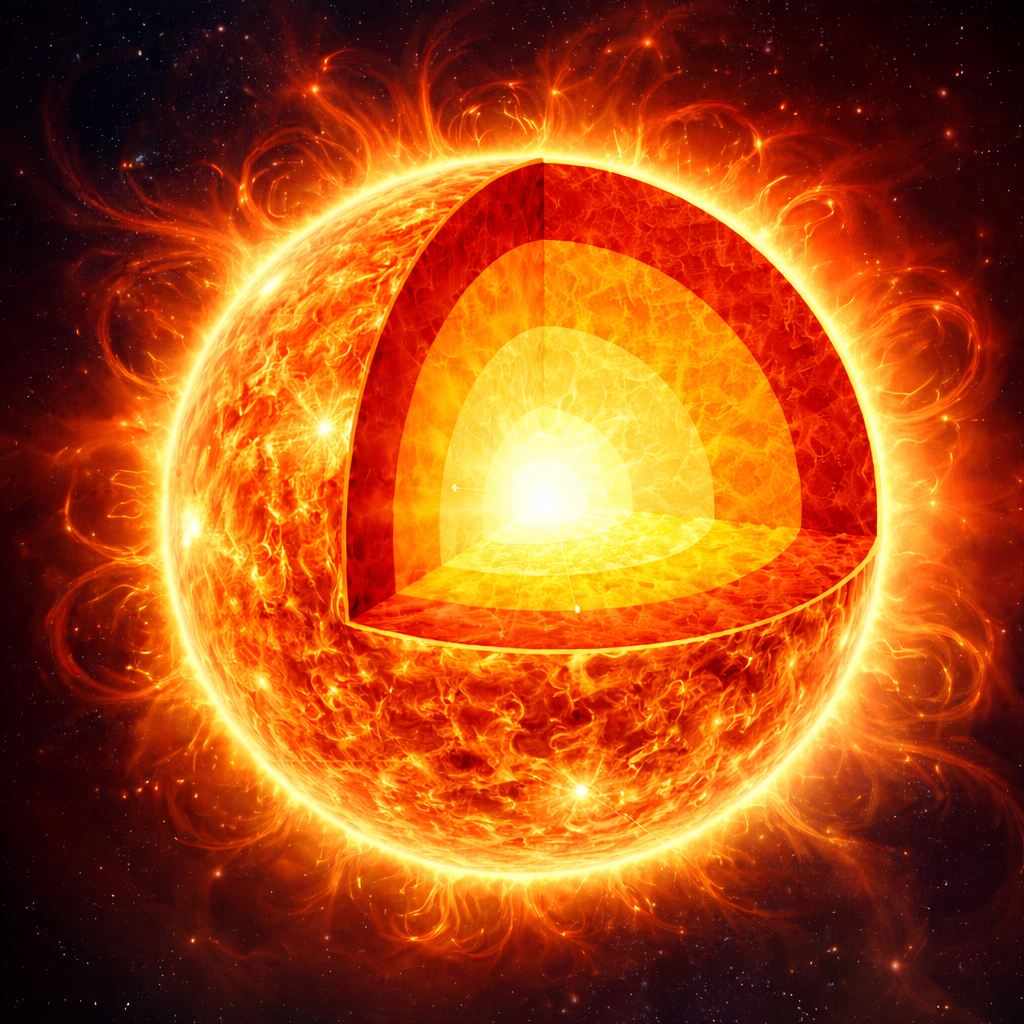
Reference frame used on this page
Solar size constant used
- Nominal solar radius
- 695,700 km (a standard nominal conversion constant used in astronomy)
Source: Nominal constants reference derived from IAU 2015 Resolution B3.
Overall composition (photosphere)
- By mass (“by weight”)
- Hydrogen ≈ 73.46%, Helium ≈ 24.85% (with the remainder as heavier elements at much smaller fractions)
- By number of atoms (common educational shorthand)
- Often stated as ~92% hydrogen and ~8% helium, reflecting number fractions rather than mass fractions
Sources: nominal radius reference (IAU-derived) and photospheric composition tables; NASA also publishes a number-fraction style summary. :contentReference[oaicite:0]{index=0}
At-a-glance: zones, temperatures, and where they sit
| Layer / Zone | Where it is | Temperature (reported ranges) | Composition / state (fact-limited) |
|---|---|---|---|
| Core | Central region; reported thickness ~138,000 km | ~15 million °C (core temperature) | Plasma dominated by H/He; hydrogen fusion to helium powers the Sun |
| Radiative zone | Between core and convection zone; extends to ~0.7 solar radius (fractional boundary) | Not a single value; energy transported outward primarily by radiation (photon diffusion) | Highly ionized plasma; photons repeatedly absorbed and re-emitted |
| Convection zone | Outermost interior; extends from ~200,000 km below the surface to the photosphere | ~2,000,000 °C at the base; cooler upward toward the surface | At its base, temperatures are “cool” enough that heavier ions can hold onto some electrons, increasing opacity |
| Photosphere | Visible “surface”; ~400 km (250 miles) thick above the visible disk center | ~6500 K (bottom) down to ~4000 K (top); commonly described as ~5,500 °C overall | Plasma where most visible light escapes; granulation is observed here |
| Chromosphere | ~400 km to ~2100 km above the photosphere | ~4000 K (bottom) to ~8000 K (top); other NASA communications describe rises to ~20,000 °C in parts | Ionization increases with height; dynamic region above the photosphere |
| Transition region | Very thin boundary between chromosphere and corona; ~100 km thick (one cited value) | Rapid rise from ~8000 K to ~500,000 K | Strong gradients in temperature and ionization |
| Corona | Outermost atmosphere; starts around ~2100 km above the photosphere (per one NASA definition) | ≥ 500,000 K, up to a few million K; NASA also describes ~2 million °C / ~3.5 million °F values | Extremely hot, very low-density plasma; source region for solar wind |
Sources: NASA Sun facts; NASA “Layers of the Sun” image article; NASA/MSFC solar interior; NASA “Layers of the Sun” blog post for terminology. :contentReference[oaicite:1]{index=1}
Core
NASA describes the core as the hottest part of the Sun, where hydrogen is fused into helium. It reports a core temperature of about 27 million °F (15 million °C) and a core thickness of about 86,000 miles (138,000 km). :contentReference[oaicite:2]{index=2}
Temperature and scale (reported)
- Temperature
- ~15 million °C (reported core temperature)
- Thickness
- ~138,000 km
Chemical makeup and state (fact-limited)
- What it is made of
- Plasma dominated by hydrogen and helium; “hydrogen fused into helium” is the stated energy source
- What changes with time
- Helium is produced in the core by fusion (a compositional change in the core relative to the outer layers)
Radiative zone
NASA describes energy moving outward from the core by radiation, with photons “bouncing around” in the radiative zone and taking about 170,000 years to reach the top of the convection zone. :contentReference[oaicite:3]{index=3}
A NASA heliophysics instructional PDF describes the radiative transport continuing until about 0.7 of the solar radius. :contentReference[oaicite:4]{index=4}
Where it sits (reported)
- Position
- Between the core and the convection zone; radiative transport continues until ~0.7 solar radius
Composition and physical state (what can be stated cleanly)
- State
- Hot, dense plasma; photons repeatedly interact with charged particles
- Bulk chemistry
- Still dominated by hydrogen and helium overall; heavy elements exist in trace fractions compared to H/He (photosphere composition provides the standard reference point)
Convection zone
NASA describes the convection zone as the outermost layer of the solar interior and states it extends from a depth of about 200,000 km up to the visible surface. :contentReference[oaicite:5]{index=5}
Temperature and depth (reported)
- Depth range
- From ~200,000 km below the surface to the photosphere
- Base temperature
- ~2,000,000 °C at the base of the convection zone (reported)
Chemistry / ionization note (reported)
- Opacity-relevant detail
- At the base of the convection zone, heavier ions (e.g., C, N, O, Ca, Fe) can retain some electrons, increasing opacity and making radiation transport less effective
Photosphere
NASA describes the photosphere as the deepest layer we can observe directly and reports it extends from the visible surface to about 250 miles (400 km) above that, with temperatures from about 6500 K (bottom) to about 4000 K (top). :contentReference[oaicite:6]{index=6}
Thickness and temperature (reported)
- Thickness
- ~400 km above the visible surface reference point (one cited definition)
- Temperature range
- ~6500 K (bottom) to ~4000 K (top)
Chemical makeup (best grounded statement)
- Bulk composition
- Dominated by hydrogen and helium; published photospheric mass fractions are ~73.46% H and ~24.85% He by weight
- What we can say without overreach
- This is a plasma layer where most visible light escapes; fine structure includes granulation (convection patterns seen from above)
Chromosphere
NASA reports the chromosphere spans from about 250 miles (400 km) to about 1300 miles (2100 km) above the photosphere, with temperatures from about 4000 K near the bottom to about 8000 K near the top. :contentReference[oaicite:7]{index=7}
NASA also describes the chromosphere more broadly as a region where temperature rises and can reach much higher values in some descriptions of the solar atmosphere. :contentReference[oaicite:8]{index=8}
Height and temperature (reported)
- Height range
- ~400 km to ~2100 km above the photosphere
- Temperature range
- ~4000 K (bottom) to ~8000 K (top)
Chemistry / state (fact-limited)
- State
- Hot, partially ionized plasma with ionization increasing with height
- Bulk chemistry
- Still hydrogen/helium dominated; spectral diagnostics (e.g., hydrogen lines) are central for observation, but this page avoids interpretive claims beyond the cited temperature/extent values
Transition region
NASA describes the transition region as very narrow (about 60 miles / 100 km) and reports a temperature rise from about 8000 K to about 500,000 K across it. :contentReference[oaicite:9]{index=9}
Thickness and temperature jump (reported)
- Thickness
- ~100 km (one cited value)
- Temperature change
- ~8000 K → ~500,000 K (abrupt rise)
What “transition” means physically (fact-limited)
- State change
- A rapid change in temperature and ionization state over a small height range
- Boundary role
- Separates the chromosphere from the corona in one commonly used layered description
Corona
NASA defines the corona as the outermost layer, starting about 1300 miles (2100 km) above the photosphere, and reports coronal temperatures of 500,000 K or more, up to a few million K. NASA’s Sun facts page also notes the corona can reach about 3.5 million °F (~2 million °C), emphasizing that it is hotter than the photosphere. :contentReference[oaicite:10]{index=10}
Height and temperature (reported)
- Where it begins (one NASA definition)
- ~2100 km above the photosphere
- Temperature range
- ≥ 500,000 K; up to a few million K (NASA wording), with examples around ~2 million °C in NASA fact summaries
Composition and outflow (reported)
- State
- Extremely hot, very low-density plasma
- Solar wind link
- NASA describes that once material leaves the corona at supersonic speeds, it becomes the solar wind, forming the heliosphere
Source for corona-to-solar-wind relationship: NASA Sun facts. :contentReference[oaicite:11]{index=11}
Primary sources used
NASA “Our Sun: Facts” (core temperature, core thickness, photosphere temperature summary, corona temperature summary, structure order, and solar-wind statement). :contentReference[oaicite:12]{index=12}
NASA “Layers of the Sun” image article (photosphere/chromosphere/transition region/corona heights and temperatures, including the 100 km transition-region thickness). :contentReference[oaicite:13]{index=13}
NASA/MSFC SolarScience “The Solar Interior” (convection zone depth ~200,000 km, base temperature ~2,000,000 °C, and ion/electron opacity note). :contentReference[oaicite:14]{index=14}
NASA “Layers of the Sun” blog post (layer naming/terminology reinforcement). :contentReference[oaicite:15]{index=15}
Stanford Solar Center “Vital Statistics” (photospheric composition by weight: H 73.46%, He 24.85%). :contentReference[oaicite:16]{index=16}
NASA GSFC “Imagine the Universe!” Sun page (composition stated in number-fraction style: ~92% H, ~8% He). :contentReference[oaicite:17]{index=17}
Nominal solar radius reference (IAU-derived nominal constants summary PDF). :contentReference[oaicite:18]{index=18}
NASA heliophysics instructional PDF (radiative transport continuing until about 0.7 solar radius). :contentReference[oaicite:19]{index=19}