Habitable Zone Calculator & Reference Table
This page provides a quick, defensible way to estimate habitable zone distances from a star’s luminosity and an effective stellar flux model. It also includes a reference table by spectral class so you can sanity-check outputs at a glance.
What these distances represent
The “habitable zone” here is the orbital range where an Earth-like planet could plausibly maintain surface liquid water, given an Earth-like atmosphere and greenhouse behavior. The table uses conservative boundaries commonly labeled as the inner edge (Runaway Greenhouse) and the outer edge (Maximum Greenhouse).
How to use the reference table
If you know the star’s spectral class and you want a fast, order-of-magnitude estimate, use the matching row and treat the result as a baseline. If you have the star’s measured luminosity and effective temperature, the calculation section below explains how to compute more precise inner/outer distances.
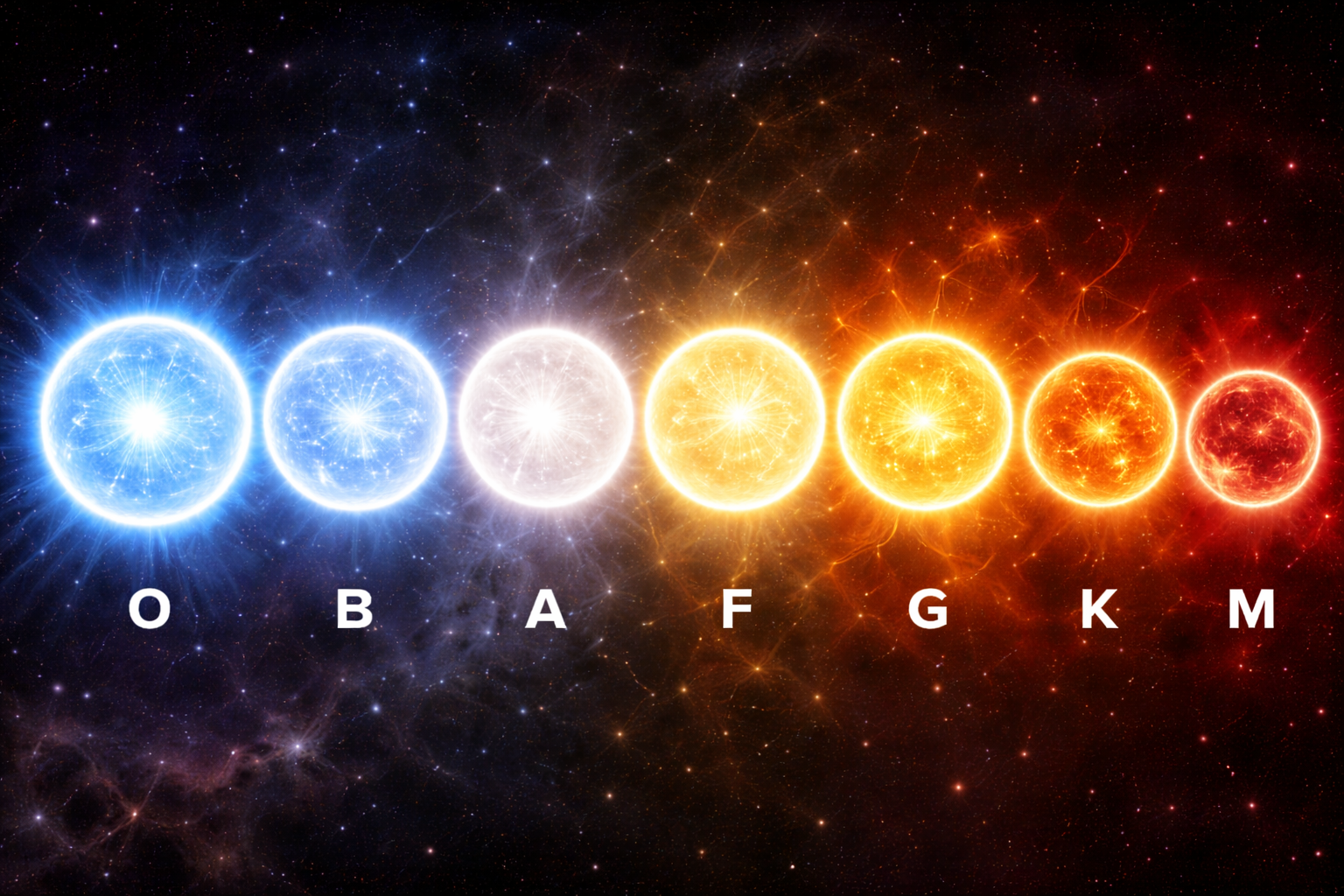
Habitable Zone Reference Flux & Distances by Spectral Class
Conservative edges shown: Runaway Greenhouse (inner) &
Maximum Greenhouse (outer).
Distances computed with d = √[(L/L⊙)/Seff] using representative main-sequence luminosities.
| Spectral Class | Teff (K) | L/L⊙ | Seff (Inner, Runaway GH) | Seff (Outer, Max GH) | HZ Inner (AU) | HZ Outer (AU) |
|---|---|---|---|---|---|---|
| O5 V | 40 000 | 8.0×10⁵ | 2.50 | 0.65 | 566 | 1.11×10³ |
| B0 V | 30 000 | 2.0×10⁴ | 2.20 | 0.55 | 95.3 | 191 |
| A0 V | 10 000 | 40 | 1.90 | 0.48 | 4.59 | 9.13 |
| F0 V | 7 200 | 5.0 | 1.75 | 0.47 | 1.69 | 3.26 |
| G2 V (Sun) | 5 780 | 1.0 | 1.11 | 0.356 | 0.95 | 1.68 |
| K5 V | 4 400 | 0.17 | 0.88 | 0.32 | 0.44 | 0.73 |
| M0 V | 3 850 | 0.08 | 0.80 | 0.27 | 0.316 | 0.544 |
| M3 V | 3 400 | 0.01 | 0.79 | 0.25 | 0.113 | 0.200 |
| M5 V | 3 100 | 0.002 | 0.75 | 0.23 | 0.0516 | 0.0933 |
Notes: Values are approximate and intended for comparative use. The effective flux thresholds Seff are commonly modeled as a function of stellar effective temperature (Teff) for Earth-like atmospheres. For star-specific work, compute Seff from the published polynomial fits using the star’s actual Teff, then compute distances from measured luminosity. O/B stars have very short lifetimes, so biological plausibility is low despite large HZ radii.
How to Calculate Habitable Zone Ranges
The table’s inner and outer distances come from a two-step conversion: pick an effective stellar flux threshold for the boundary you care about, then translate that flux threshold into orbital distance using the star’s luminosity. Conceptually, you are solving for the distance where the planet receives a specific flux relative to Earth.
d (AU) = √[(L / L⊙) / Seff]
Here, L/L⊙ is the star’s luminosity expressed in units of the Sun’s luminosity, and Seff is the effective stellar flux threshold (in “Earth flux” units) for a specific habitable-zone boundary. Higher luminosity pushes the habitable zone outward; higher Seff pulls a boundary inward.
To compute the same kind of ranges shown in the table, proceed as follows.
- Determine the star’s luminosity L/L⊙. If you have a measured luminosity, use that. If not, you can use an approximate main-sequence luminosity associated with the star’s spectral class as a baseline.
- Determine the star’s effective temperature Teff (Kelvin). This matters because modern habitable-zone models adjust Seff with spectral dependence; two stars with the same luminosity can have slightly different boundary flux thresholds depending on their spectra.
- Choose which boundaries you want. In this page, the inner edge uses “Runaway Greenhouse” and the outer edge uses “Maximum Greenhouse.” Each boundary corresponds to a different Seff.
- Obtain Seff for each boundary. For quick estimates, you can use representative values like those in the table. For higher fidelity, compute Seff from the published polynomial fit for the chosen boundary using your star’s exact Teff.
- Compute distance for each boundary using the equation above. Use the inner boundary’s Seff to compute dinner, and the outer boundary’s Seff to compute douter.
A practical interpretation is that Seff is a climate-model-informed “required irradiance” for a boundary. The inner boundary requires more incoming flux (larger Seff) and therefore sits closer to the star; the outer boundary tolerates less flux (smaller Seff) and therefore sits farther out.